

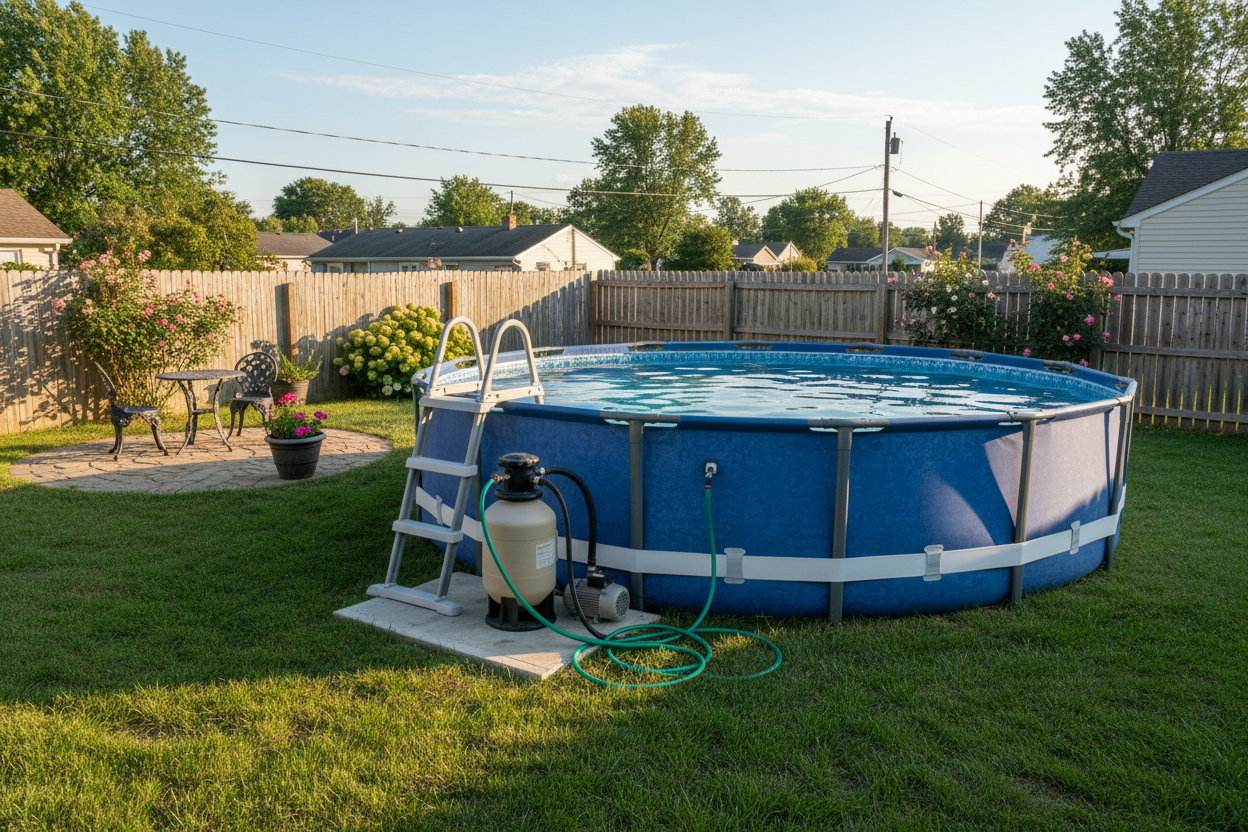
Quick answer: Most residential pools need a pool pump between 1 and 2.5 horsepower, sized so it can circulate your entire pool's water volume in 8 hours or less (this is called your "turnover rate"). The exact size depends on your pool's gallon capacity, plumbing pipe size, and any extra features like spas, waterfalls, or long pipe runs. For an average 15,000–20,000 gallon in-ground pool, a 1.5 HP pump is typically the sweet spot.
If you want the precise number for your pool, here's how to calculate it — plus a sizing chart you can use right now.
The Formula: How to Calculate Your Pool Pump Size
Pool pump sizing comes down to three numbers: your pool's volume, your target turnover rate, and your plumbing's flow capacity.
Step 1: Find Your Pool's Volume (in Gallons)
Use this formula for a rectangular pool:
Length × Width × Average Depth × 7.5 = Total Gallons
For a round pool: Diameter × Diameter × Average Depth × 5.9 = Total Gallons
Example: A 32' x 16' pool with an average depth of 5 feet = 32 × 16 × 5 × 7.5 = 19,200 gallons.
Step 2: Determine Your Required Turnover Rate
"Turnover rate" is the time it takes your pump to circulate a volume of water equal to your entire pool. Most residential pools should turn over at least once every 8 hours (some codes and heavily-used pools call for 6 hours).
Step 3: Calculate Required Flow Rate (GPM)
Total Gallons ÷ Turnover Time (in minutes) = Gallons Per Minute (GPM) needed
Example continued: 19,200 gallons ÷ 480 minutes (8 hours) = 40 GPM
Step 4: Match GPM to Pump Horsepower
Once you know your required GPM, match it to a pump that can deliver that flow against your system's resistance (plumbing size, filter, fittings, and elevation changes — collectively called "total dynamic head").
Pool Pump Size Chart by Pool Volume
|
Pool Volume (Gallons) |
Recommended Flow (GPM) |
Typical Pump Size |
|
Up to 10,000 |
20–30 GPM |
3/4 – 1 HP |
|
10,000 – 15,000 |
30–40 GPM |
1 – 1.5 HP |
|
15,000 – 20,000 |
40–50 GPM |
1.5 HP |
|
20,000 – 25,000 |
50–60 GPM |
1.5 – 2 HP |
|
25,000 – 30,000+ |
60–70 GPM |
2 – 2.5 HP |
|
Above-ground pools (avg.) |
20–35 GPM |
3/4 – 1.5 HP |
These are general guidelines. Your actual ideal size also depends on your plumbing diameter (1.5" vs. 2" pipe), filter type, and how far the pump sits from the pool.
For above-ground pools specifically, pump sizing is often expressed in gallons per hour (GPH) rather than GPM: pools under 5,000 gallons typically do well with a 1,000–1,500 GPH pump, pools between 5,000–10,000 gallons need 1,500–2,500 GPH, and anything over 10,000 gallons calls for 2,500+ GPH — or a two-speed/variable-speed model for better energy efficiency.
If you're shopping for a pool and pump together, you can browse the full range in the pools and hot tubs collection or see everything outdoor and pool-related in this collection. A few popular pool sizes to use as a reference point:
-
Compact option: Intex 84" x 23.62" Outdoor Rectangular Frame Above Ground Swimming Pool — a smaller footprint that pairs well with an entry-level 1,000–1,500 GPH pump
-
Mid-size option: Bestway Steel Pro MAX 10'x30" Round Above Ground Swimming Pool with Pump — a 10-foot round pool that comes with a properly matched pump included
-
Larger option: Bestway Steel Pro MAX 12' x 30" Above Ground Swimming Pool Set — more water volume, so double-check the included pump's GPH against the chart above before relying on it long-term
-
Standalone pump: if you already own a pool and just need a replacement, the Bestway Flowclear 1,000 GPH Above Ground Swimming Pool Filter Pump is sized for pools under roughly 5,000 gallons
Other Factors That Affect Pool Pump Sizing
1. Pipe Size Matters as Much as Horsepower
A bigger pump doesn't help if your plumbing can't handle the flow. As a rule of thumb:
-
1.5" pipe: max ~40–50 GPM
-
2" pipe: max ~50–70 GPM
-
2.5"–3" pipe: max ~70–120 GPM
Oversizing a pump beyond what your pipes support wastes energy and causes excess pressure, which stresses your filter and fittings.
2. Variable-Speed vs. Single-Speed Pumps
Variable-speed pumps let you run higher flow for cleaning/heating and a slower, efficient speed for daily filtration — often cutting energy costs by 50–70% compared to single-speed pumps. Many state and local codes now require variable-speed pumps for new pool installations, so it's worth checking your local regulations.
3. Spas, Water Features, and Solar Heating
If your pump also needs to power a spa jet system, waterfall, or solar heater, you'll typically need to size up, since these features demand additional flow beyond basic filtration.
4. Elevation and Distance
The farther your pump sits from the pool, and the more elbows/valves in the plumbing, the more "head pressure" it has to overcome — which can call for a slightly larger pump even at the same pool volume.
Share:
Most Popular Pool Sizes in America: Above Ground Pool Size Data Guide