

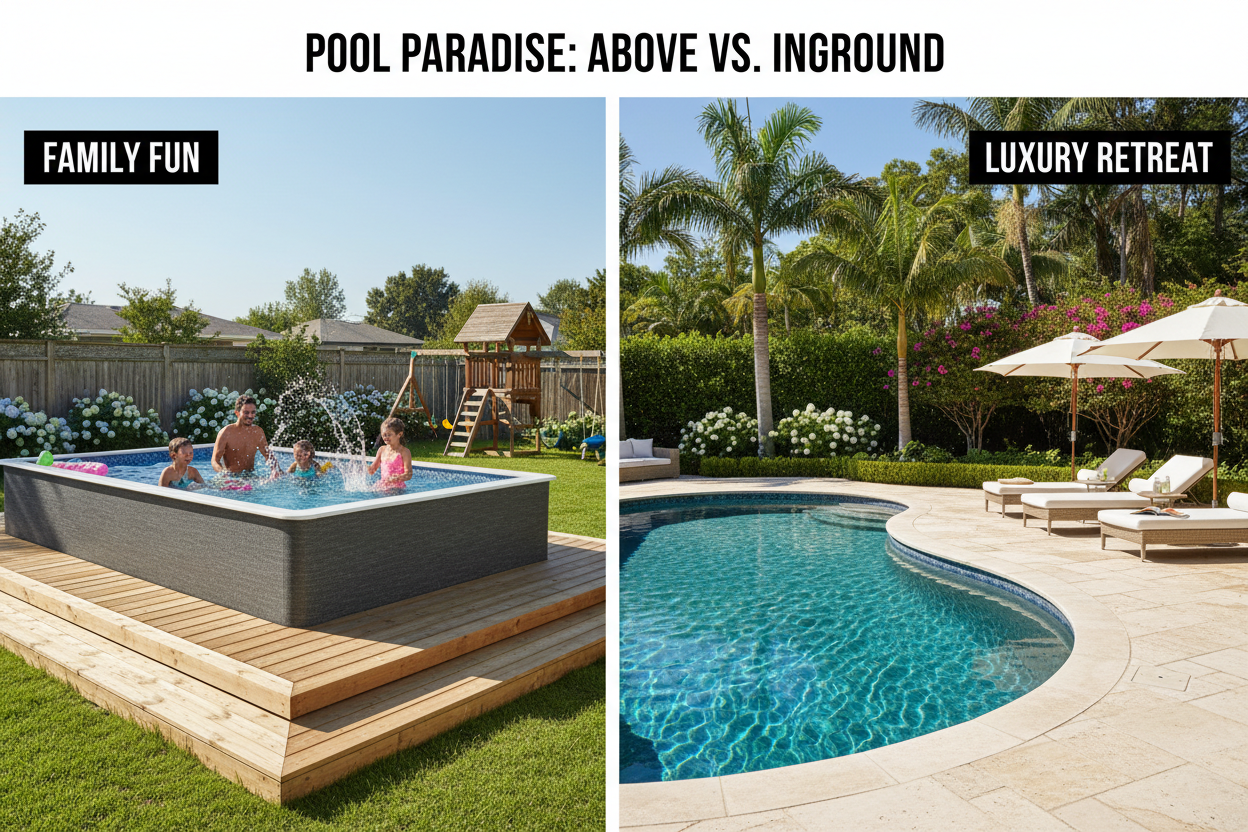
Quick answer: For most homeowners, an above ground pool is the more practical choice. It costs a fraction of an inground pool ($1,500–$6,000 vs. $35,000–$100,000+), can be set up in days instead of weeks or months, requires no excavation or permits in most areas, and today's models — with steel or resin frames, integrated pumps, and oversized rectangular and oval options — deliver a swimming experience that rivals an inground pool at a much lower cost and commitment. An inground pool is a bigger, more permanent investment that only pays off if you're staying in your home for decades and can absorb the higher upfront cost and maintenance. For speed, flexibility, and value, above ground wins for the vast majority of buyers.
Here's a full side-by-side breakdown to help you decide.
Above Ground Pool vs Inground Pool: Quick Comparison
|
Factor |
Above Ground Pool |
Inground Pool |
|
Average Cost |
$1,500 – $6,000 |
$35,000 – $100,000+ |
|
Installation Time |
1–3 days |
3–8 weeks |
|
Lifespan |
7–15 years |
20–50+ years |
|
Home Value Impact |
Minimal to none |
Can increase resale value |
|
Customization |
Limited shapes/sizes |
Highly customizable (shape, depth, features) |
|
Portability |
Can be disassembled/moved |
Permanent |
|
Maintenance Cost |
Lower |
Higher |
|
Best For |
Renters, tight budgets, temporary use |
Long-term homeowners, permanent backyard upgrade |
Cost: The Biggest Difference
Cost is usually the deciding factor, and it's where above ground pools have a decisive advantage.
Above ground pools typically run $1,500 to $6,000 for the complete setup — pool, pump, filter, and ladder included in most kits. Larger and premium models with steel frames, oversized rectangular or oval shapes, and integrated decking still land well under $10,000, a fraction of what inground installation costs.
Inground pools typically cost $35,000 to $100,000+, depending on material (vinyl liner, fiberglass, or gunite/concrete), size, and added features like waterfalls, lighting, or a spa. Gunite pools, which offer the most customization, tend to be the most expensive — and that figure often doesn't include ongoing costs like resurfacing, equipment replacement, or fencing required by local code.
For most budgets, an above ground pool delivers the vast majority of the swimming experience at roughly 5–10% of the cost.
Installation Time
Above ground pools can often be set up in a single day to a few days, since they sit on top of the ground and don't require excavation, permits, or contractors in most areas. Many are ready to fill with water the same weekend they arrive — a huge advantage if you want to actually use the pool this season instead of next.
Inground pools require excavation, plumbing, electrical work, permitting, and curing time (especially for concrete/gunite pools), which typically takes 3 to 8 weeks from start to finish — and that's the best case. Permit delays, weather, and contractor scheduling routinely push projects well beyond that window.
Lifespan and Durability
Above ground pools typically last 7 to 15 years, and with today's heavier-gauge steel frames and UV-resistant liners, well-maintained models regularly land at the higher end of that range. Because replacement cost is so low relative to an inground pool, upgrading to a newer model every decade or so is a realistic option rather than a major financial event.
Inground pools last much longer on paper — 20 to 50+ years for concrete/gunite, and 15 to 30 years for fiberglass or vinyl liner — but that lifespan comes with periodic resurfacing, liner replacement, and equipment overhauls that add real cost over time. Longevity is an advantage, but it's not maintenance-free longevity.
Home Value and Resale
Inground pools can add measurable resale value in warm-climate markets where pools are expected, though the return on investment varies widely by region and rarely covers the full installation cost. In colder climates or markets where pools aren't the norm, an inground pool can even be a neutral or negative factor for some buyers.
Above ground pools generally add little to no resale value and, in some cases, buyers view them as a removal cost rather than a perk — since they're seen as temporary, movable structures rather than permanent home features.
Customization and Design
Inground pools win decisively on customization. You can choose the shape, depth, steps, tanning ledges, integrated spas, lighting, and finishes to match your yard and design vision.
Above ground pools come in a more limited set of round and oval shapes and standard depths (typically 42"–54" wall height), though many modern models offer upgraded frames, patterns, and integrated decking kits to improve the look and feel.
Maintenance and Ongoing Costs
Both pool types need regular filtration, chemical balancing, and cleaning, but inground pools tend to cost more to maintain due to larger water volume, more complex plumbing, and features like heaters or automatic covers.
Above ground pools are generally cheaper to run and easier to close for winter, since they're simpler systems with smaller water volumes and more accessible equipment.
Which One Should You Choose?
-
Choose an above ground pool if: you want to get swimming fast, keep costs low, avoid permits and excavation, or aren't ready to commit to a permanent structure. This covers the large majority of homeowners.
-
Choose an inground pool if: you own your home long-term, have a large dedicated budget, and want a fully custom, permanent backyard feature — with the understanding that it comes with a much higher cost and longer timeline.
Shop Above Ground Pools by Size
Modern above ground pools come in a wide enough range of shapes and sizes that most yards and budgets can find a strong fit. A few popular options:
-
Compact/starter: Bestway Steel Pro MAX 10'x30" Round Above Ground Swimming Pool with Pump — an affordable entry point that includes the pump
-
Mid-size: Bestway Steel Pro MAX 15' x 48" Round Above Ground Swimming Pool — more swimming room with a deeper 48" wall
-
Family-size oval: Bestway Hydrium 24' x 12' x 52" Oval Above Ground Swimming Pool Set — a larger footprint with a woodgrain finish that reads more like a built-in feature
-
Largest rectangular: Intex 32' x 16' x 52" Rectangular Ultra XTR Frame Above Ground Swimming Pool Set — one of the largest above ground options available, built for serious swimming and entertaining
Browse the complete range in the above ground pools collection, or search all current above ground pool options to compare sizes, brands, and price points side by side.
Frequently Asked Questions
Is an above ground pool worth it? Yes — for the large majority of homeowners, an above ground pool delivers most of the swimming experience of an inground pool for a fraction of the cost and a fraction of the wait. It's an especially strong fit for families who want to be swimming this season, don't want to deal with permits or excavation, or would rather put the savings toward decking, landscaping, or other backyard upgrades.
Does an above ground pool add value to a home? Generally, no — above ground pools are viewed as temporary, removable structures and typically add little to no resale value, unlike inground pools which can add value in the right market.
How long do above ground pools last compared to inground pools? Above ground pools typically last 7–15 years, while inground pools can last 20–50+ years depending on the material (concrete/gunite lasting longest, followed by fiberglass and vinyl liner).
Can you put an inground pool where an above ground pool was? Yes, but the ground will need to be professionally graded, compacted, and inspected before inground installation, since above ground pools sit on a leveled surface rather than excavated ground.
Which is cheaper to maintain, above ground or inground pools? Above ground pools are generally cheaper to maintain due to smaller water volume and simpler equipment, while inground pools cost more due to larger systems and often additional features like heaters or automatic covers.
The Bottom Line
Inground pools have their place for homeowners with a large, dedicated budget and a decades-long time horizon. But for most people, an above ground pool is the smarter move: a fraction of the cost, a fraction of the wait, and — with today's larger, sturdier models — nearly all of the swimming experience. If you want to be swimming this summer instead of waiting on permits and contractors next year, above ground is the practical choice.
Ready to find your size? Shop above ground pools or browse the full above ground pool selection to compare options.
Share:
Robotic vs. Manual Pool Cleaners: Which Pool Cleaner Is Right for You?
Best Pool Cleaner for Above Ground Pools: What to Look For