

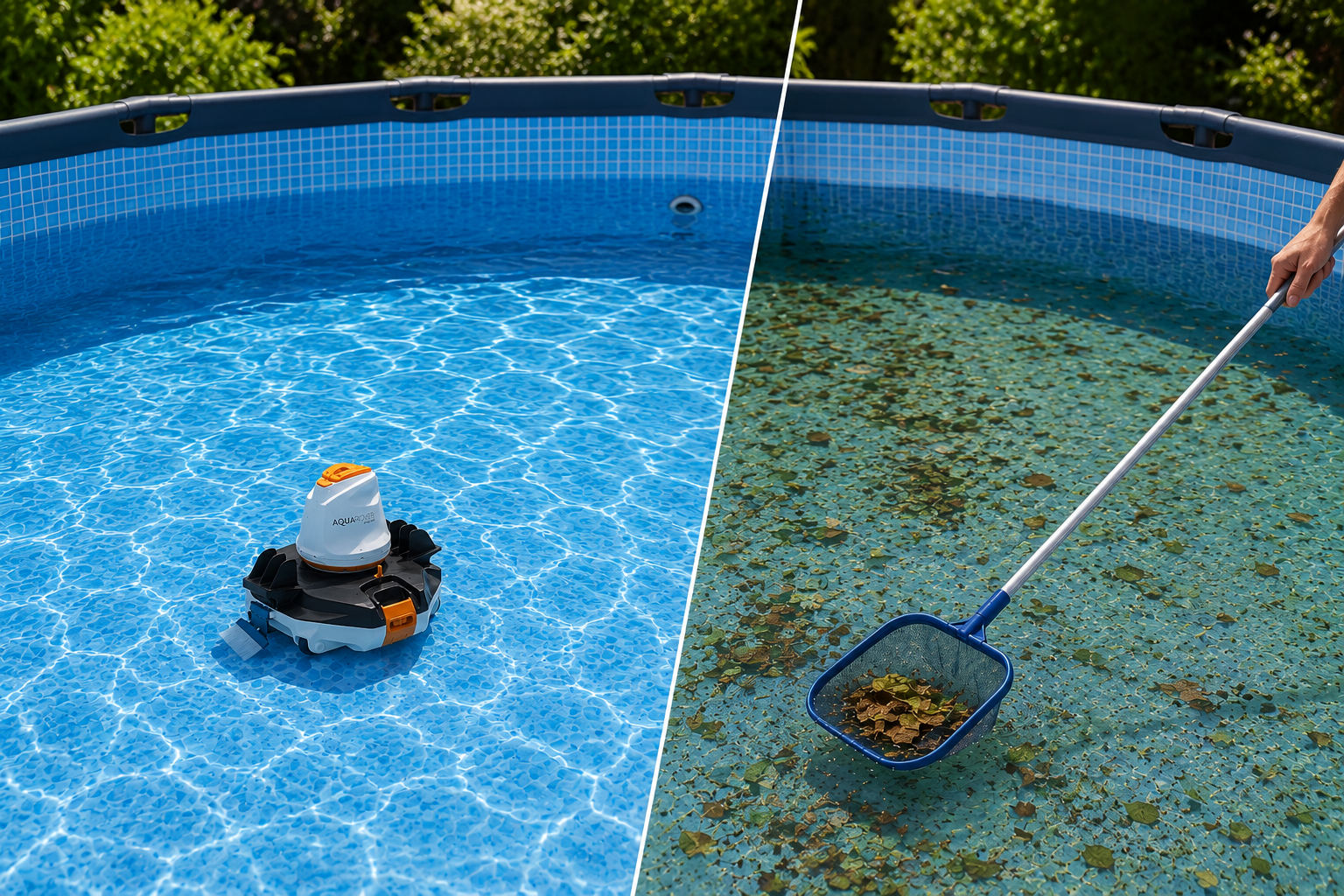
Keeping your swimming pool clean is an essential part of pool ownership, but choosing the right cleaning method can be confusing. Should you use a traditional manual pool vacuum, or is a robotic pool cleaner worth the investment?
The right choice depends on your pool size, surface, cleaning frequency, budget, and how much time you want to spend maintaining your pool.
In this pool cleaner comparison, we'll explain how robotic and manual pool cleaners work, compare their advantages and disadvantages, and help you determine which option is best for your pool.
Robotic vs. Manual Pool Cleaners: Quick Comparison
| Feature | Robotic Pool Cleaner | Manual Pool Vacuum |
|---|---|---|
| Cleaning effort | Minimal | High |
| Automation | Automatic | Requires manual operation |
| Setup | Usually quick | Requires connection/setup |
| Cleaning consistency | Consistent | Depends on the user |
| Floor cleaning | Yes, depending on model | Yes |
| Wall cleaning | Some models | Requires manual brushing/vacuuming |
| Energy source | Battery or electrical connection | Pool filtration system or manual equipment |
| Best for | Convenience and frequent cleaning | Budget-conscious pool owners |
| Initial cost | Usually higher | Usually lower |
What Is a Robotic Pool Cleaner?
A robotic pool cleaner is an automated device that moves through your swimming pool and collects dirt, leaves, sand, and other debris.
Depending on the model, a robotic cleaner can clean the pool floor, walls, and sometimes the waterline. Many models have their own filtration system, allowing them to collect debris without relying entirely on your pool's main filtration system.
For example, the Kokido Cordless Robotic Pool Cleaner is designed for both in-ground and above-ground pools with flat bottoms up to 24 feet in diameter. Its cordless design and automatic stop-and-go navigation make it a convenient option for routine pool cleaning.
Benefits of Robotic Pool Cleaners
1. Less manual work
Once placed in the pool, an automatic cleaner can handle much of the cleaning process for you. This means less time spent pushing a vacuum head around the pool.
2. Consistent cleaning
A robotic cleaner can be used regularly to prevent debris from accumulating. Frequent cleaning can make routine pool maintenance easier.
3. Convenient operation
Cordless models are particularly convenient because they eliminate the need to manage long hoses or power cables during cleaning.
4. Some models clean walls
Higher-end robotic pool cleaners can scrub and vacuum pool walls in addition to the floor. Always check the manufacturer's specifications to make sure a cleaner supports your specific pool surface and shape.
5. Excellent for busy pool owners
If you use your pool frequently or don't want pool maintenance to take up your weekend, automation can be a major advantage.
What Is a Manual Pool Vacuum?
A manual pool vacuum is a traditional cleaning tool that requires you to physically move the vacuum around the pool.
Many manual systems connect to a telescoping pole and the pool's filtration system. You guide the vacuum head across the bottom of the pool to remove dirt and debris.
Manual pool cleaners are generally straightforward and can be a good choice when you want an affordable cleaning solution or need precise control over where you clean.
For smaller above-ground pools, VMInnovations also offers pool maintenance kits that combine cleaning tools into a single setup. For example, the Intex Pool Maintenance Kit is designed for pools 16 feet and smaller and includes a telescoping shaft with interchangeable skimmer and vacuum heads.
Benefits of Manual Pool Vacuums
Lower upfront cost: Manual equipment is generally less expensive than purchasing a fully automated robotic cleaner.
More control: You decide exactly where the vacuum goes, making manual cleaning useful for targeting specific areas.
Simple technology: Manual equipment doesn't require batteries, motors, sensors, or electronic navigation systems.
Good for occasional cleaning: If your pool doesn't collect much debris, a manual vacuum may be all you need.
Robotic vs. Manual Pool Cleaners: Which Is Better?
There isn't one universal winner.
A robotic pool cleaner is usually the better choice if your priority is convenience, consistent cleaning, and reduced manual effort.
A manual pool vacuum can make more sense if you have a smaller pool, clean infrequently, or want to minimize your initial equipment cost.
Choose a robotic pool cleaner if:
-
You want to spend less time cleaning.
-
Your pool collects debris frequently.
-
You want automated cleaning.
-
You prefer cordless equipment.
-
You want a cleaner that can potentially clean walls as well as the floor.
Choose a manual pool vacuum if:
-
You have a smaller pool.
-
You don't mind cleaning manually.
-
You want a lower-cost solution.
-
You need precise control over the cleaning process.
-
Your pool doesn't accumulate significant debris.
What About Above-Ground Pools?
Above-ground pools can benefit significantly from automated cleaning, but compatibility is important.
Not every robotic cleaner is designed for every above-ground pool. Before buying, check the manufacturer's specifications for pool dimensions, bottom shape, wall compatibility, and required connections.
For example, the automatic cordless vacuum is designed for flat-bottom above-ground pools up to 194 square feet and uses a cordless design for unrestricted movement across the pool floor.
For larger frame pools, VMInnovations also carries pool-and-cleaner packages such as the Intex Ultra XTR Frame Pool with Robot Vacuum.
How Often Should You Use a Pool Cleaner?
The ideal cleaning frequency depends on how often you use the pool, the surrounding environment, weather, and how much debris enters the water.
As a general approach, inspect the pool regularly and clean it whenever you notice leaves, dirt, sand, or other debris accumulating. During periods of heavy use or after storms, more frequent cleaning may be necessary.
A robotic cleaner can make frequent maintenance easier because you don't have to manually vacuum the pool every time.
Final Verdict
When comparing a robotic pool cleaner vs. a manual pool vacuum, think about what matters most to you.
A manual vacuum offers simplicity, control, and a lower entry cost. A robotic cleaner offers automation and convenience, making it particularly attractive for pool owners who want to reduce the amount of hands-on maintenance.
The best pool cleaner is ultimately the one that matches your pool's size, shape, surface, filtration system, and cleaning requirements.
Looking for a pool cleaner? Explore VMInnovations' selection of robotic and manual pool cleaning equipment to find an option that fits your pool.
Share:
Pool Maintenance FAQs: Answers to Your Most Common Pool Questions
Above Ground Pool vs Inground Pool: Which Is Right for You?